


Entering the 2026-2027 academic year, colleges and universities across the U.S. are leaning more confidently in the direction of requiring or recommending test scores than at any time since the global pandemic:
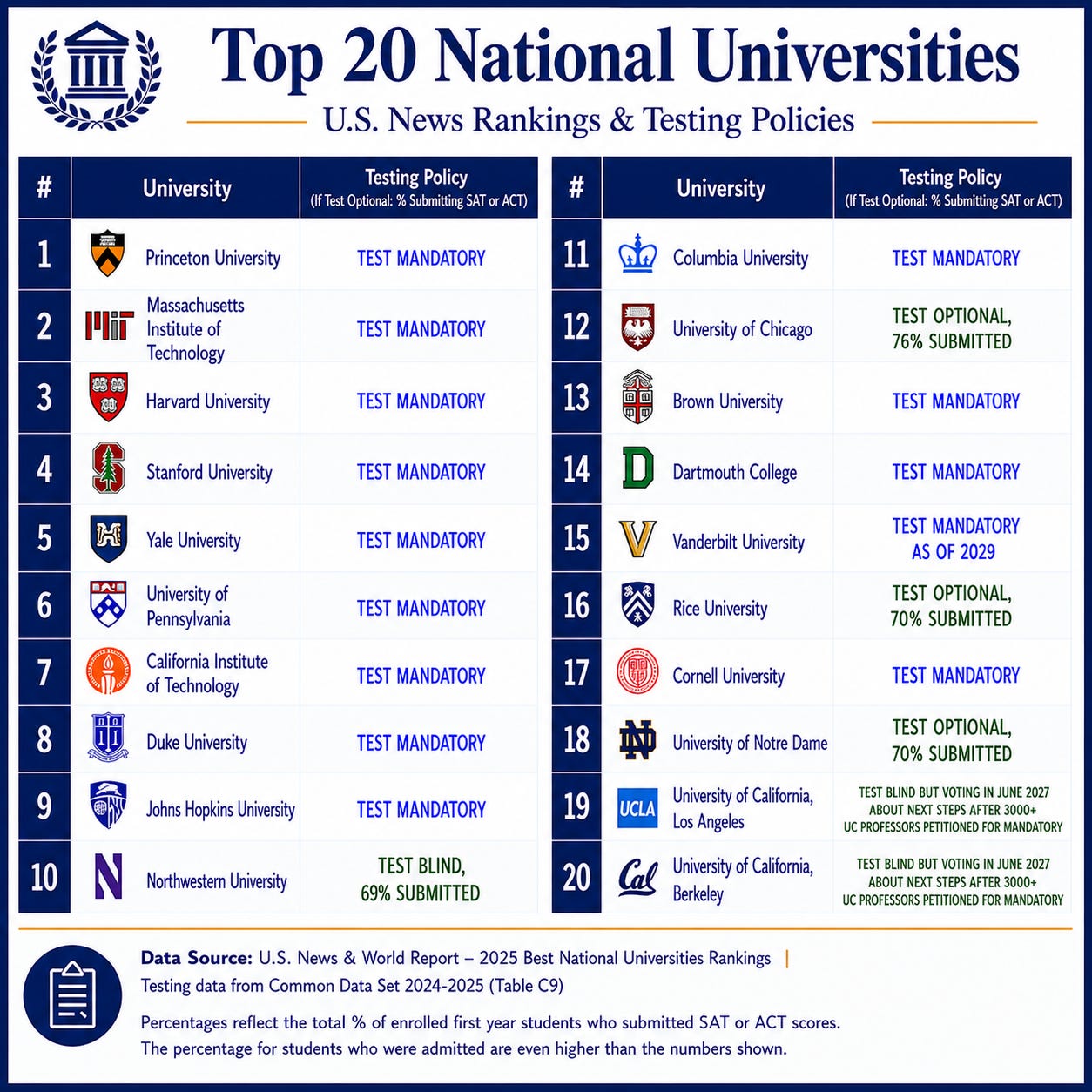
Nearly every top 20 school (based on U.S. News & World Report’s 2025 Best National Universities list) either requires test scores or received scores from over 2/3rds of enrolled applicants.
The University of California schools are strongly signaling a move away from the current SAT/ACT-blind policy, spurred in part by an emphatic June 2026 letter supporting admissions testing signed by over 3,000 UC faculty.
Many of the most popular public university systems and all military service academies have gone test mandatory.
What comes next?
Without belaboring the point, one prestigious university president after another has commented on the record that test scores have become stronger signals than grades of college readiness, especially in challenging STEM programs. As the dominoes keep falling, the safe bet is that most selective schools that required entrance exam scores before 2020 will likely return to test mandatory policies. On the other hand, non-selective schools–those that accept 50% or more of applicants–have little incentive to add barriers to entry and will probably maintain some level of optionality.
Will score requirements go up or down?
One of the many ways colleges deftly navigated the uncertain waters of the test-optional era involved score reporting. Many applicants received informal suggestions from admissions reps to either report or withhold test scores based on certain defined lines. Holding back scores didn’t necessarily help applicants at schools offering substantial submitter advantage, but the colleges themselves definitely benefitted. In effect, these schools increased their reported middle 50 (25th to 75th percentile score ranges for the previous year’s incoming freshman class) which raised rankings based on perceived selectivity… while also accepting students who would have otherwise brought that score range down. Talk about having your cake and eating it too.
So, logic would dictate that the middle 50 for many of these newly ascendant schools may come back down to earth, at least slightly. However, another way the pandemic period reshuffled the higher education deck has been the rising popularity–and selectivity–of southern public universities. Case in point, test-mandatory University of Georgia now boasts a middle 50 of 32-35 for Early Action applicants, with a slightly lower 31-34 overall–pretty much the same as Dartmouth!
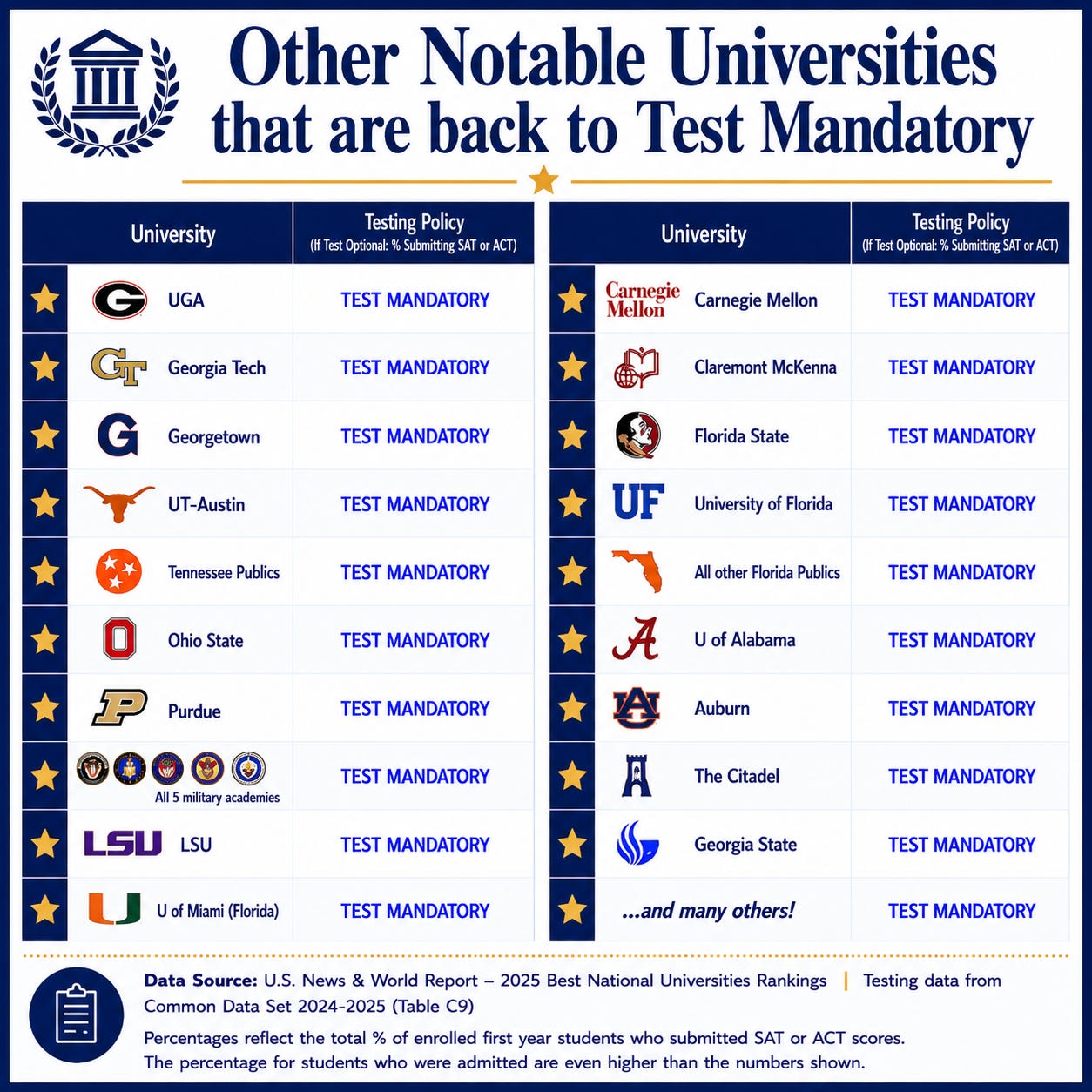
In fact, popular public flagships from Florida to Texas have become much harder to get into while still requiring test scores, an economic necessity in places with generous in-state college scholarships. So score requirements are as unlikely to drop among this class of institution as they are in the ranks of the Ivy League and ultra-selective set.
That said, if we’ve learned anything about college admissions over the last decade, it’s that change is the only constant. Consider the trends described here as prevailing for the high school graduating class of 2027 and likely for the classes of 2028. Beyond that time frame, we’ll have to find out together…
(Thanks to Brian Eufinger of Edison Prep for the graphics.)
Can you believe the August SAT is less than 2 weeks away?! If you live in the Rochester, NY area, you still have time to enroll in one of our SAT/ACT Boot Camps. No matter where you live, now is the perfect time to plan for fall prep. Set up a free expert consultation to set your teen up for SAT & ACT success!

APPLICATION ACTION STEPS
🎓 Learn how to use the Common App.
🎓 Hear how Jeff Selingo defines a dream school.
🎓 Master pro tips for the SAT Desmos graphing calculator.
🎓 Recognize the most troublesome tested words on the June 2026 SAT.
QUESTIONS?
Do you have any burning questions to ask or want to share an issue, article, or resource our readers should know about? Just reply to this email. We appreciate you!
I'm very curious to see what happens to the 25th percentile numbers at these schools...Georgetown's number has stayed low (most recent was 1405). And I think all of these schools had much lower numbers pre COVID. There are only so many kids with 1500/34 to go around -- maybe 75k? So either the top 40 schools are going to take almost every student with those scores (to fill their top 75% of students), or these score ranges are going to drop.