


The cost of everything seems to be rising these days, but higher consumer prices don’t necessarily lead to greater producer profits. Exhibit A is definitely college. But first the news…
COLLEGE NEWS
Hate to say I told you so, California-style: Who—except anyone who works directly with students—could have predicted the disastrous fallout from the infamous University of California system’s 2020 decision to eliminate SAT & ACT scores in admissions. Now professors at one campus after another are demanding better readiness data. Sometimes, reality wins, even the Golden State.
AI not exactly AOK on campus: Every bold claim that tomorrow’s professionals need to master AI tools today ignores just where that learning is meant to take place. A massive study using survey data from 95,513 students in a representative sample of 20 major U.S. public research universities revealed lots of use and, unsurprisingly, misuse. Rumor has it that faculty and administrators were relieved to be excluded from the study.
Affordable Excellence in the Empire State: In a recent op-ed, State University of New York Chancellor John B. King Jr. promoted cutting college costs and challenges, writing, “If higher education wants to rebuild public trust, start with making college affordable.” The statewide tuition freeze at SUNY four-year campuses definitely backs up King’s bold words to the benefit of New York students.
If you haven’t planned for summer test prep yet, it’s not too late. Chariot Learning has scheduled both a 28-hour and a 14-hour online SAT group class, more SAT/ACT Boot Camps throughout Rochester, and tutoring availability for students everywhere. Set up a call to determine which option is right for your teen!

BIG IDEA
If you’re not attuned to current conditions in higher education, you might be genuinely surprised at how many schools will cost more than $100K in the 2026-27 academic year, at least for full pay students. You’d compare how much you paid for college to current sticker prices with ever-widening eyes and mounting disbelief. And you’d be right to do so. Yet, if you then concluded that colleges must be comfortably flush with funding, you’d be dead wrong.
Almost every single college and university today appears to be struggling.
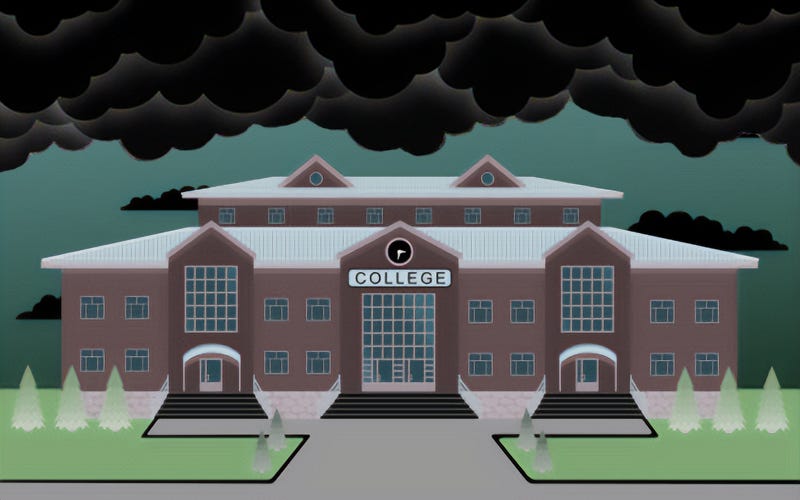
Now, if you’re as cynical as I am, you might be reaching for the world’s smallest violin; billion dollar institutions rarely deserve sympathy. But a recent conversation with my college counseling friends Aly Beaumont and Meg Joyce of Admissions Village changed my perspective on the plight of increasingly imperiled institutions of higher learning. These are terrible times to try to run a college, and not just because much of the media has waged war on academia and the ROI of an undergraduate education. That dreaded demographic cliff hasn’t really impacted admissions yet, but schools are still beleaguered by a dizzying array of financial challenges:
Adjusted for inflation, families are actually paying less for tuition, according to College Board.
The cost of college sports is rising with no end in sight. In fact, the majority of Division I athletic departments operate at massive deficits subsidized in part by student fees.
The U.S. higher education sector experienced a 17% drop in new international enrollment and a 36% plunge in F-1 visa issuances in 2025, according to NAFSA: Association of International Educators.
AI panic is driving more students to trades and away from traditional humanities majors, triggering widespread pauses or cuts to programs.
The federal government has been waging war against many institutions of higher education.
That final statement is by no means political; rather, this is open acknowledgement that many of the challenges confounding U.S colleges come right from the top:
Massive cuts to research funding
Multi-million dollar lawsuits and pressure for settlements
An endowment tax that can rise well over $200 million.
Each one of these factors deserves deeper analysis, which you can find in the first of Aly Beaumont’s three-part opus on Trends in Admissions and Higher ED. But the undeniable facts present two important implications for anyone applying to college: (1) pay close attention to an institution’s short-term financial health and (2) their considerable losses can be your gain when the time comes to appeal aid.
Higher education and the institutions that deliver degrees and so much more have been essential cornerstones of America’s economic and cultural success. In tough times, even those with profoundly deep pockets can struggle and no school is considered too big to fail. Share some sympathy, if you can, for colleges. As they go, so go we all.
APPLICATION ACTION STEPS
🎓 Explore SAT vs ACT Math distributions for 2026.
🎓 Learn how to find Deep Fit in the college search.
🎓 Find out if you’re on track for testing and scholarship timelines.
🎓 Track the most troublesome tested words on the May 2026 SAT.
QUESTIONS?
Do you have any burning questions to ask or want to share an issue, article, or resource our readers should know about? Just reply to this email. We appreciate you!
Loved the college funding and tuition articles linked in this newsletter. Really important stuff for parents trying to figure out college funding!