


While most colleges and universities seem to be struggling financially, few nationally known schools have actually closed theirs doors recently… until now. But first the news…
COLLEGE NEWS
When college means business: Despite the perception that every new college student is focused on STEM majors, the majority of the Top 10 most in-demand bachelor’s degrees are actually business related. Well, how else will you pay off those student loans?
The early worm gets accepted: Ever hear the saying, “If you’re not early, you’re late,” and wonder what even means? In the realm of higher ed, it means that roughly 65% of applicants submitted ED/EA applications this year. Furthermore, according to Guidewell Global, many selective schools filled 45–60% of seats before Regular Decision. So, don’t be late next year.
Madhouse in Madison: The Board of Regents of the Universities of Wisconsin unanimously voted to fire President Jay Rothman after he declined to resign quietly. While the system’s financial and enrollment struggles have been well-documented, the action by the board has stirred up strong political controversy. With hope, the Wisconsin Idea put forth by former UWM President Charles Van Hise—“I shall never be content until the beneficent influence of the University reaches every family of the state”— will prevail.
Believe it or not, now is the time to plan for both spring and summer testing. If you’re not already working with someone, let me and my expert team at Chariot Learning help you make the most of the months ahead!

BIG IDEA
In 1958, the presidents of three private colleges joined the chairman of the University of Massachusetts Amherst in appointing a committee to reexamine the assumptions and practices of liberal arts education. These findings were famously disclosed in The New College Plan: A Proposal for a Major Departure in Higher Education:
“The four institutions sponsoring this report have been aware for some time of the imminent demands upon American colleges to provide space and opportunity for a vastly enlarged body of students. In an effort to extend their own programs and make better use of their resources, during the past five years they have engaged in an increasing number of educational enterprises. Last year they considered the possibility of creating a fifth institution in their general area, to which they might contribute and with which they might develop new departures in educational methods and techniques. Their hope was to plan a new college which would provide education of the highest quality at a minimum cost per student.”
That “New College”, founded in 1965 and open for instruction in 1970, was Hampshire College.
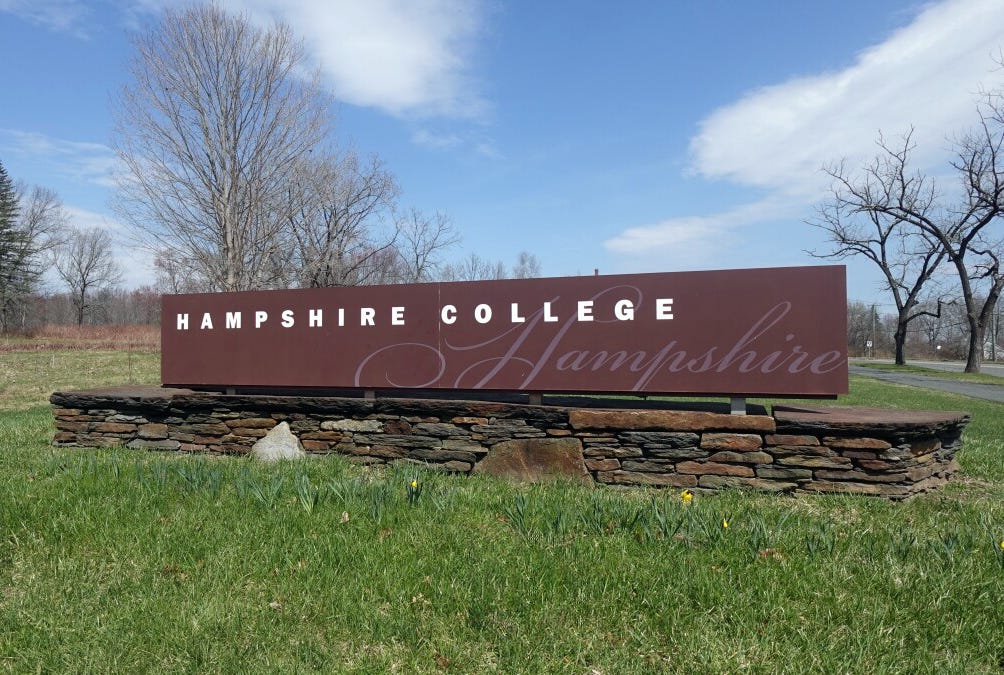
Hampshire College definitely represented a break from the rigid structures of traditional academia. Imagine a college without majors or letter grades but rather concentrations and narrative evaluations from professors that detail their specific strengths and areas for growth. Hampshire even threw out the concept of years in favor of Divisions designed to funnel academic inquiry into an advanced culminating project. Best of all, students seeking more traditional classes and clubs had access to Amherst College, Smith College, Mount Holyoke College, and UMass Amherst as part of the Five College Consortium.
Yet, while Hampshire enjoyed international fame for its unique value proposition, times grew tight in Amherst’s Pioneer Valley. Ironically, the school’s financial difficulties weren’t obvious to the public until Hampshire drew national attention in 2015 by announcing that the school would not accept SAT or ACT scores from applicants:
“In our admissions, we review an applicant’s whole academic and lived experience. We consider an applicant’s ability to present themselves in essays and interviews, review their recommendations from mentors, and assess factors such as their community engagement and entrepreneurism. And yes, we look closely at high school academic records, though in an unconventional manner. We look for an overarching narrative that shows motivation, discipline, and the capacity for self-reflection. We look at grade point average (GPA) as a measure of performance over a range of courses and time, distinct from a one-test-on-one-day SAT/ACT score.”
While that particular admissions stance became quite common during the pandemic period, Hampshire led the test optional-to-blind pack by several years in adopting an admissions policy that seemed consistent with the institution’s experimental nature. That said, some in the industry--present company included--suspected a less selfless motive at work. Simply put, Hampshire was struggling financially:
“In 2015, Hampshire College was representative of many test-optional colleges. 2014-15 Tuition, Room, and Board at this liberal arts school in Massachusetts totaled a tick under $60,000. Before the school waived SAT and ACT scores entirely, its 18% yield rate was barely high enough to keep the school off the list of Colleges with the Most Ignored Acceptance Letters.”
Speculation crystallized into certainty in 2019 when the college announced that it would not be accepting a new class in the fall. The death spiral mirrored by so many other institutions finally culminated in a recent announcement signaling the end of an important experiment in higher education:
“The Board of Trustees voted to permanently close Hampshire College following the fall 2026 semester. The rationale behind this painful vote reflects several realities. The College no longer has the resources to sustain full operations and meet our regulatory responsibilities. The inability to substantially grow enrollment would mean extraordinary cuts to our operating budgets to educate the student body we can reasonably anticipate.”
The loss of Hampshire College will be felt keenly by many, not just its alumni, boosters, and neighbors but also by the faculty, staff, and students of many schools in similar straits. Hampshire has served as a visionary institution since its inception, so certain lessons from its rise and fall are worth noting:
An experiment in education is simply that: an experiment, destined neither to succeed nor fail but rather, if conducted properly, to reveal key insights or data.
As glorious as a liberal arts education can be, many private colleges are both extremely expensive relative to public options and insufficiently differentiated from one another.
Prospective college students and their parents in today’s market seem to be leaning more towards majors and programs with more obvious prospects for ROI. Other essential academic programs are in for some challenging times until the pendulum swings back the other way… which it undoubtedly will.
All colleges and universities are under extreme financial pressure, which means that every policy change and grand pronouncement should be considered through a lens of shrewd pragmatism. At most institutions, for example, test optional and test blind admissions policies increase the number of total applications and higher-yield applicants, which in turn boosts revenues and rankings.
Hampshire College blazed trails and set trends in higher education. But rather than considering the school’s conclusion as singular as its inception, expect many other institutions--just as special and beloved in their communities--to suffer the same fate. Like the proverbial canary in a coal mine, Hampshire serves as an early indicator of real peril in the college space.
NAME THAT SCHOOL
Think you know a lot about colleges? Try to guess this institution of higher education. (Find the answer at the end of the newsletter.)
This New England school was founded relatively recently but has a long history of political activism. In 1977, it became the first college in the nation to divest its endowment from companies doing business in apartheid-era South Africa.
The college operates a working organic farm central to its “Farm-to-School” program as well as community gardens and a “living building” that generates its own energy and processes its own waste.
The campus is adjacent to the Eric Carle Museum of Picture Book Art, which celebrates the works of the author of The Very Hungry Caterpillar and other authors.
Famous alums include documentarian Ken Burns, author Jon Krakauer, and actress Lupita Nyong’o. The founders of Ben & Jerry met at the school but didn’t graduate from there.
The mascot Al the Frog--specifically the Leaping Frog--reflects the school’s non-competitive, whimsical, and nature-focused identity.
APPLICATION ACTION STEPS
🎓 Try a tool that helps you find college fit.
🎓 Learn how multitasking makes us dumber.
🎓 Track the most troublesome tested words on the March 2026 SAT.
🎓 Understand how divorce can impact college admissions and financial aid.
HOTLINE
Do you have any burning questions to ask or want to share an issue, article, or resource our readers should know about? Dial up the College Eagle hotline through this easy form. We appreciate you!
NAME THAT SCHOOL ANSWER
Surprise—we’re still talking about Hampshire College, young by the standards of most colleges but bold enough to be remembered long after it’s gone. Go Hampsters!